
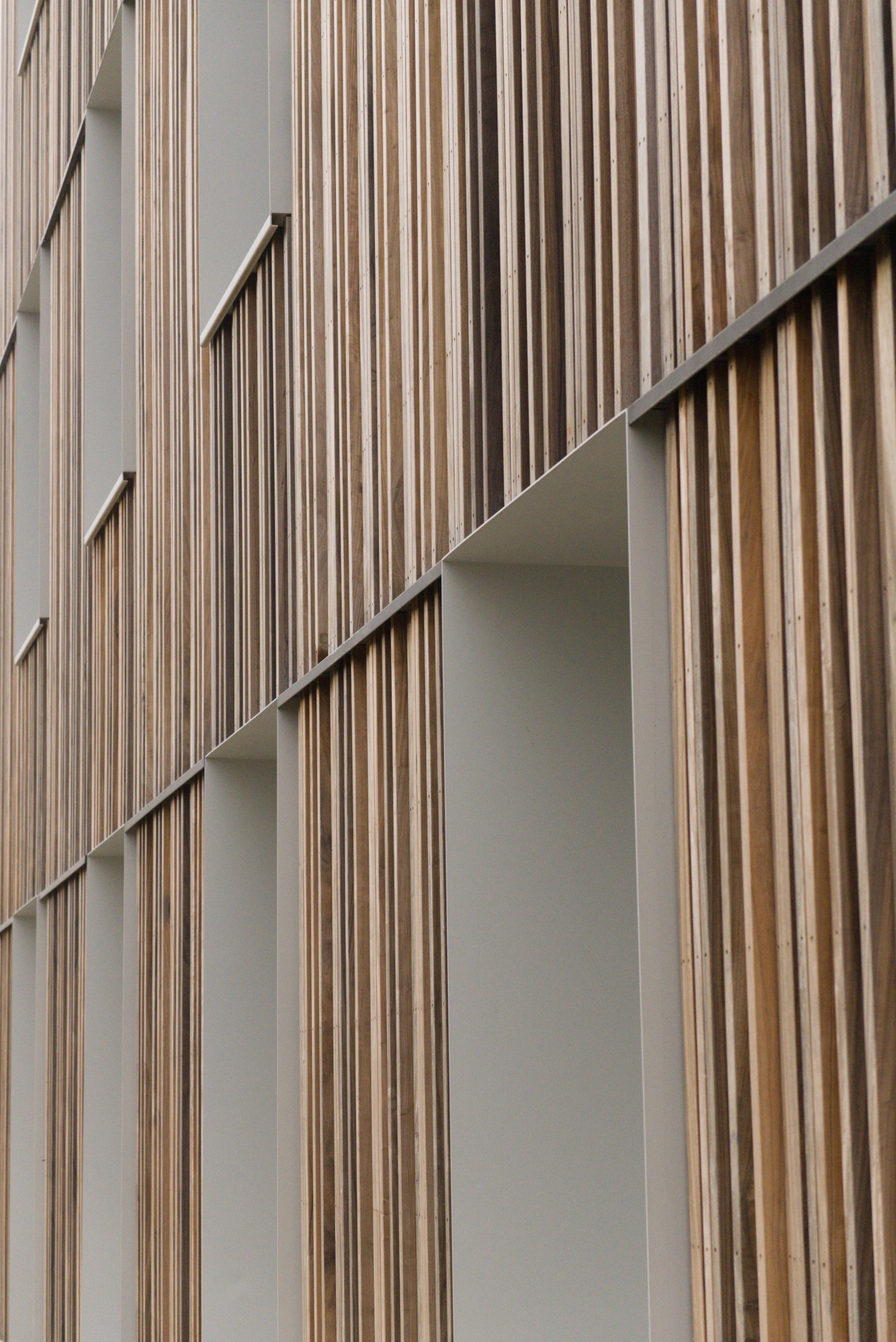
20-26 Dellizotti
20-26 Dellizotti is a flagship circular building project in Bettembourg, combining demountable off-site construction, bio-based materials, and controlled natural ventilation to deliver low-carbon performance and high indoor air quality.
To reduce the building’s carbon footprint and keep construction costs under control, the project relies on an advanced form of off-site construction: demountable, and built using bio-based materials, in partnership with Pailletech. On the operations side, the objective is clear: reduce energy consumption - and therefore maintenance and consumables costs - through the implementation of the Controlled Natural Ventilation (CNV) principle, in partnership with 22-26 GmbH. Finally, to reach a high standard of indoor air quality (IAQ), all finishing materials were assessed up front, either through their safety data sheets or through low-cost laboratory tests. A specific focus on electromagnetic fields also made it possible to avoid any risk for occupants.
Timber can raise concerns for companies used to working with concrete. Designing a hybrid timber/concrete building - and above all a demountable one - was the primary challenge. A second challenge was integrating the VNC system and managing remote control/commissioning from Austria, without the specialists traveling on-site.
Deliver a building that is pleasant and comfortable for the client and its occupants, in summer and winter, while keeping costs under control.
The solution focused on designing a demountable hybrid timber–concrete system fully compatible with Controlled Natural Ventilation (CNV), requiring both a deep understanding of CNV constraints and a buildable, dismantlable assembly strategy for precast concrete elements produced on site and timber/straw elements manufactured in a factory. Particular attention was given to the interfaces between different element types to anticipate assembly accurately. By detailing time-optimized assembly and sequencing (“chrono-details”) in close collaboration with the architects and DZ-Construct (the off-site integrator), on-site installation ultimately proved simpler and faster than expected. A rigorous execution process and structured follow-up helped reduce surprises on a project combining multiple innovations. For indoor air quality (IAQ), an initial common-sense shortlist limited the number of products requiring formal validation while quickly converging on the right choices, which were then confirmed through acceptance checks carried out by Neobuild as an independent third party, within a pilot flagship project designed to generate practical feedback and lessons learned.

One step away from your next project move. Talk to the studio.