
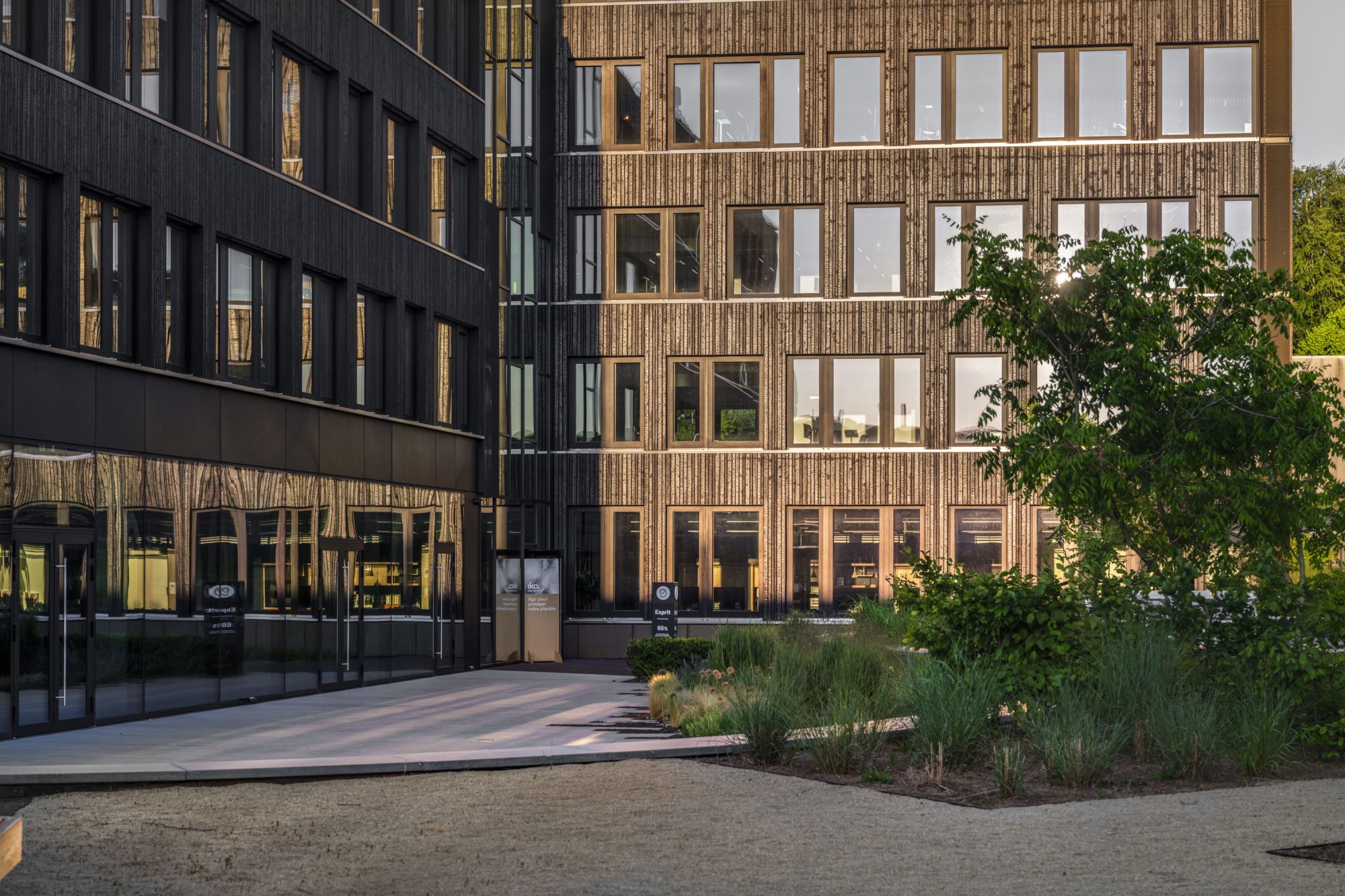
WELL 22 - office building

Enhancing smart buildings through artificial intelligence
Three strategic objectives drove the initiative of integrating IA for energy management:
1. Regulatory & ESG Alignment: identify additional reduction potential in electricity consumption (scope 2 emissions) to further improve the asset’s carbon performance
2. Value Creation: the building is a newly delivered asset equipped with an advanced Building Operating System enabling precise energy monitoring. The objective was to unlock additional value from this infrastructure by integrating Artificial Intelligence (AI), enhancing performance for both owner and tenants.
3. Cost Management: reduce electricity consumption related to technical systems and common areas, while preserving occupant comfort and operational reliability
The building was already equipped with a SAUTER HVAC and a fully integrated Building Operating System (BOS) improving performance supervision.
The challenge was not technological alone - it was also operational and organizational:
◦ How can additional energy savings be identified in a building already designed as “smart”?
◦ How can an AI layer interact effectively with an existing HVAC regulation system without compromising operational stability?
◦ How can governance be structured when AI directly influences technical building systems?
◦ Demonstrate the tangible impact of AI-driven energy optimization within an already high-performance building.
◦ Generate measurable energy savings enabling a short payback period.
◦ Create a replicable management framework for AI-driven building operations.
1. Proof of Concept
◦ Footbot.io, a Luxembourg-based software company, had previously demonstrated significant results at the LIST conference venue.
◦ The solution optimized HVAC energy consumption dynamically based on actual room occupancy, using CO₂ sensors as a real-time proxy for usage intensity.
◦ This validated the potential of AI to enhance energy efficiency beyond traditional regulation systems.
2. Integration into the Building Operating System
Footbot.io was integrated by the BOS operator, enabling AI-driven control of HVAC parameters. The project combined technology integration with organizational transformation:
◦ Establishing clear operational protocols, as the AI solution directly interacted with HVAC control systems
◦ Designing a new governance framework clarifying roles and responsibilities between the technical services responsible for SAUTER HVAC maintenance & the facility manager supervising the BOS
3. Performance monitoring & carbon impact
In order to ensure transparency and financial accountability, we structured:
◦ Performance tracking dashboards
◦ Carbon footprint assessment updates
◦ Return-on-experience analysis
Results
12% reduction in electricity consumption for common areas and a return on investment achieved within 2 years:
◦ The model is replicable across office, retail, and mixed-use portfolios
◦ It leverages existing BOS infrastructure while being applicable directly on an existing HVAC installation
◦ It accelerates decarbonization without heavy CAPEX


One step away from your next project move. Talk to the studio.